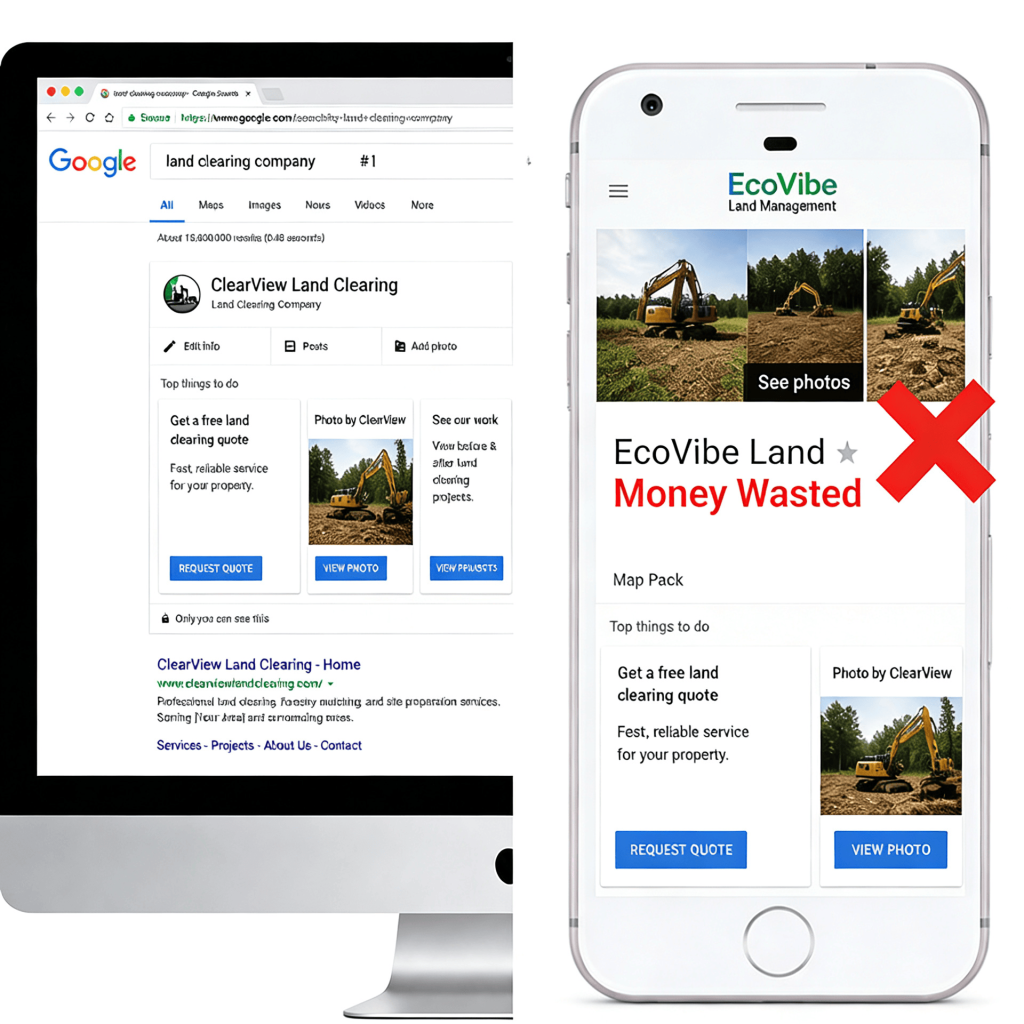
Stop Competing with Yourself: The Marketing Audit

More marketing doesn’t always lead to more growth; sometimes it results in wasted expenditure. Many contractors invest in ads without realizing they are already ranking at the top of local search results, paying for clicks in areas where they already dominate. This isn’t expansion but rather self-competition. 

To develop an effective contractor marketing strategy, you must first establish a baseline awareness of your current successes before committing more resources to advertising.

This article guides you through a simple marketing audit to ensure you’re not paying for ads in locations where you’re already number one in the Google Map Pack.

Understanding what it truly means to compete with yourself.

Imagine a homeowner searches for “land clearing near me,” and your business appears at the top of the Google Map Pack. Just below, your paid ad is also visible. This indicates that you’re investing in potential organic traffic. This situation exemplifies self-competition. Although ads can be beneficial, consistently paying for clicks in competitive areas can deplete your budget that could be better allocated. Effective marketing strategies help safeguard your profit margins.

Understanding the Google Map Pack Advantage

The Google Map Pack appears above organic listings.

It shows:

  • Business name
  • Reviews
  • Rating
  • Phone number
  • Location

Ranking first in the Map Pack gives you prime visibility, as many local searchers click directly from it. Holding that position is highly valuable. However, paying for additional exposure in the same area might not greatly boost your overall leads.

Step One: Identify Your Service Keywords

Start your audit by listing your main services.

For example:

  • Land clearing
  • Excavation
  • Driveway grading
  • Site prep
  • Brush removal

Add “near me” or your specific city name to each search. These are the most important searches. Clarity starts with understanding what clients enter into Google.

 Step Two: Search Like a Customer

Use a clean browser window or incognito mode.

Search your core keywords from different devices and, if possible, different parts of your service area.

Take notes:

  • Where do you rank in the Map Pack?
  • Do you appear in the top three?
  • Are you first?
  • Are ads showing above your listing?

This gives you real-world visibility insight.

Step Three: Compare Organic Strength to Ad Spend

Next, look at your ad campaigns.

If you are paying for keywords where you already dominate organically, ask:

Is the ad bringing incremental volume?
Or is it just capturing clicks you would receive anyway?

Sometimes ads protect against competitors.

Other times, they simply increase cost per lead without increasing total inquiries.

An effective contractor marketing strategy requires allocation, not duplication.

Why Ranking at the Top Spot #1 Changes the Equation

When your position in the first spot in the Map Pack is accompanied by strong reviews, you are a winner of:

  • High visibility
  • Trust signals
  • Immediate call access
  • Mobile click convenience 

If you’re paying for ads in that exact spot, you might be oversaturating a position you already own. Ownership diminishes the requirement for reinforcement. 

Situations When Ads Still Make Sense 

This doesn’t imply that you should completely remove ads. 

Ads are useful when: venturing into new service areas, advertising a new service, facing challenges in areas with low ranking, or covering seasonal slow periods. The point is strategic deployment. Ads should broaden your footprint, not match it.

brand consistency marketing check

Redirecting Budget to Growth Zones

Once your audit identifies areas of organic dominance, shift ad budget toward:

  • Neighboring cities where the ranking is lower
  • High-income zip codes you want to penetrate
  • Specialized services that need exposure
  • Seasonal campaigns

This approach expands overall market reach rather than strengthening current positions. Growth is driven by expansion, while duplication tends to increase costs.

Monitoring Cost Per Lead by Area

Track leads based on geographic sources. If a region generates many organic calls and high close rates, cut back on paid advertising there. Conversely, if another region yields few organic calls, allocate resources more strategically. Clear geographic insights enhance marketing efficiency, which in turn safeguards profit.

Reviewing Your Google Business Profile Strength

Your Map Pack position depends on:

  • Review volume
  • Review consistency
  • Response rate
  • Local relevance
  • Photo updates

Enhancing your Google Business Profile can yield greater benefits than simply increasing ad expenditure. Organic authority builds gradually over time, whereas ads reset once spending ceases.

Avoiding Ego-Based Marketing

Some contractors advertise just to have their name appear twice on the page. This visibility may boost ego, but marketing driven by ego can be costly. Decisions should rely on data. If you’re already leading in the market, focus on maintaining that position through reviews and high-quality service instead of wasting money on unnecessary ads.

The Seasonal Audit Habit

Perform a marketing audit twice yearly. Markets evolve, competitors update, and new services emerge. Your rankings might improve in some areas while dropping in others. Regular reviews help avoid unnecessary spending, which can harm profit margins.

The Risk of Ignoring This Step

Without auditing, you may:

  • Overspend in strong markets
  • Underspend in growth areas
  • Miss ranking drops
  • Ignore competitor shifts

Clarity avoids waste, and waste hampers growth.

Aligning Marketing With Capacity

If your schedule is booked in one region, decrease paid exposure there and increase it where there’s room to grow. Marketing activities should align with operational capacity, as misalignment can cause stress.

Developing a More Effective Contractor Marketing Approach

A strong contractor marketing strategy includes:

  • Review growth
  • Organic ranking focus
  • Strategic ad targeting
  • Geographic clarity
  • Budget allocation review

Each piece complements the others, but no piece should duplicate another unnecessarily.

Final Thoughts

Stop competing with yourself. If you hold the top spot in the Google Map Pack, safeguard that position with reviews, quick responses, and regular updates. Avoid wasting money on ads in areas where you already have a strong presence. Focus your marketing budget on expanding into new territories rather than defending existing ones. Conducting a straightforward audit can uncover hidden inefficiencies. Removing these inefficiencies is often the quickest route to growth.

Share the Post:

Related Posts

Join Our Newsletter

© 2026 ExcavatorNetworkUSA.com - All rights reserved